Tuesday, December 22, 2020

Aliens by 2035?


Aliens By 2035?
 
A credulous article about SETI claims that we'll find aliens "soon:" http://nautil.us/blog/why-well-have-evidence-of-aliensif-they-existby-2035

Oh? Seth Shostak will bet me a cup of coffee that we'll find aliens by 2035?

If I were a betting man, I'd take that bet. And he might as well buy it for me now, before inflation brings the price of that coffee to $20 or more!

There are many, many problems with Dr. Shostak's piece.
  1. "I'm optimistic by nature--as a scientist, you have to be."
           -Nope. As a scientist, you have to be skeptical. Popperian falsification, anyone? Optimism--or lack thereof--is irrelevant.
     
  2. "Given the current state of SETI efforts and abilities, I feel that we're on the cusp of learning something truly revolutionary."
           -This is going to sound quite crass, but it's true: nobody cares what Dr. Shostak--or anyone else--feels about might happen in the future. Especially when that possibility is so vaguely stated!
           "...learning something truly revolutionary" could refer to anything from finding an extraterrestrial civilization to discovering that magnetic fields are regulated by microscopic men riding microsopic stationary bikes.
           And upon what is this assertion based? A feeling. Very scientific.

  3. "Most of our experiments so far have used large radio antennas in an effort to eavesdrop on radio signals transmitted by other societies..."
           -What if they don't want us to listen to them? Characterizing the SETI search this way is very disturbing, even if this was nothing more than a poor choice of words. If the people who are involved in this program see it as a cosmic game of peeping-tom, that raises the question of whether it's morally right to be pursuing this topic!
     
  4. [quote continued from #3] "...an approach that was dramatized by Jodie Foster in the 1997 movie Contact."
           -Mmm, a made-for-Hollywood scientific endeavor. Because serious science is always fit to be summarized and dramatized in 2 hours.
           This can be forgiven, though, because the search for aliens is inherently interesting.
__

Michael Crichton--yes, the science-fiction author--made some insightful observations about the sociology of science in his famous CalTech lecture in 2003. In that talk, he blasted the apparent mathematical legitimacy of SETI--the Drake equation--as "meaningless." You can read a transcript of that talk here:
http://stephenschneider.stanford.edu/Publications/PDF_Papers/Crichton2003.pdf
__

Ultimately, SETI is at least partly a PR move. Dr. Shostak discusses his belief that SETI can aid science literacy in a 2002 article: http://adsabs.harvard.edu/full/2004IAUS..213..535S  I would particularly like to point you to page 2, where Dr. Shostak writes "Because of their emotional content, the media can generate excitement for science."

But let's never allow that goal--to get kids excited about science--to compromise the integrity of what makes science so useful.

-At its core, SETI needs money to continue the search for extraterrestrial intelligence. In order to attract funding, it needs to generate publicity. And it generates publicity by saying things like 'we'll find aliens by 2035.'

Unfortunately, the more mundane truth is that we don't know a) the nature of what we're looking for, b) when it will arrive (or whether it will arrive), c) if we'll even know a signal when we detect it, or d) if any such signals even exist!

This fact--that we're blindly groping around a pitch-black desert in hopes of stumbling across a pool of water--doesn't make for good headlines. But it has the virtue of being the truth.

__

Despite all the above curmudgeonly objections, I'd personally contribute some funding to SETI if I ever become a multi-billionaire! But to be brutally honest with myself, the probability of that actually happening is smaller than the chance of a pointy-eared humanoid descending from a spaceship and bidding me, "Live long and prosper."


***
This New Scientist article reports on a mathematical case that we may never detect extraterrestrial signals--not even if they cover half of our galaxy!

Shostak has been spoonfeeding this optimistic prediction to media outlets for years. I give him credit for sticking with his initial prediction of contact by ~2035, rather than moving the goalposts. But if 2035 comes and goes with no alien signals yet, Dr. Shostak will be in his early 90s...if he's even still around to see whether or not his prediction has come true. And if it hasn't, I seriously doubt that anyone will criticize a man of such advanced age. But the history of futurists is littered with disappointment; I have no reason to suspect that this prediction will be any different.

If you're really down on futurism and/or want to read a morose counterpoint to the exuberant optimism of most predictions about the future, read this insightful takedown of the whole concept of predicting the future.

***
Wondering about the social media usage of actual college students? 
Check out the results of this totally informal—but realsurvey.

In case you missed it, I review some fantastic, easy-to-use, and FREE stats programs here.
For more help explaining statistical concepts and when to use them, 
please download my freely available PDF guide here!
https://drive.google.com/open?id=0B4ZtXTwxIPrjUzJ2a0FXbHVxaXc

Sunday, September 6, 2020

Pay-to-play?


Pay-to-play? Predators in the Academy

If you're an early-career researcher, and you want to be a professor, how do you demonstrate your suitability for an open position? You typically have to:
  • Provide a cover letter
  • Provide a Curriculum Vitae
  • Provide a Teaching Statement and/or a Statement of Research
  • Provide your unofficial transcripts
But how do you really set yourself apart from other early-career researchers who are applying for the same position?

One way is to be well-connected; a recommendation from a luminary in your field can go a long way! Another option is to have an extensive list of publications, especially if your publications are in prestigious journals with a high impact factor.

It's the latter that I'd like to focus on today.

Since there is an absolutely massive amount of demand for journal publications, the free market has responded to the pressure: the rise of so-called "predatory journals."

https://contexts.org/articles/pay-to-play-journals/
https://www.theguardian.com/environment/climate-consensus-97-per-cent/2014/sep/18/who-should-pay-to-publish-scientific-research
An interview with Jeffrey Beall and overview of the challenges of identifying "predatory publishers:" http://www.nature.com/news/investigating-journals-the-dark-side-of-publishing-1.12666
An archived version of the famous (or infamous) Beall's List: https://beallslist.weebly.com/
A sting operation to identify predatory publishers who will accept anybody as an editor: http://www.nature.com/news/predatory-journals-recruit-fake-editor-1.21662
It's gotten to the point where people are publishing journal articles about predatory journals! http://www.bioone.org/doi/10.2983/035.035.0101
An advocate of open access to research has become disillusioned by the systemic abuses that take place under the auspices of openness: https://ocsdnet.org/confessions-of-an-open-access-advocate-leslie-chan/

How do you tell a "good" journal from a "bad" one? Well, if you're looking for a single list...alas, there isn't one. However, the DOAJ [Directory of Open Access Journals] lists some helpful guidelines on how to identify a high-quality publisher. And the website ThinkCheckSubmit.org [archived version here] also gives authors guidelines.

Monday, July 13, 2020

Around Academia


Around Academia

The first in a roundup series that I've decided to call "Around Academia."

Is 'self-care' just another way of policing people's thoughts, by compelling them to feel happy? Or might it be a cynical marketing ploy to sell products? https://www.coyneoftherealm.com/blogs/news/the-tyranny-of-self-care-this-year-s-model-of-compulsive-happiness

Are early-career female researchers getting due credit for their work? https://www.coyneoftherealm.com/blogs/news/rising-early-career-female-academics-and-second-to-last-authorship
  • Some advice, whether the assertion linked above is true or not: Don't be a jerk. Give people due credit!
On a related note: should we publish fewer papers? Nelson, Simmons, and Simonsohn make a compelling case: http://opim.wharton.upenn.edu/DPlab/papers/publishedPapers/Simmons_2013_Lets%20Publish%20Fewer%20Papers.pdf
  • I can't resist including this quote from page 292: "Under the current system, researchers are heavily rewarded for having new and exciting ideas and only vaguely rewarded for being accurate. Researchers are trained to defeat the review process and conquer the publisher. Uncovering a new and true insight is quite helpful in that process, but it is hardly necessary."

    Yikes. An savage indictment of the current state of the publication process (rather than in its theoretical/ideal form)!
Are yoga and mindfulness simply fads with more hype than substance? http://blogs.plos.org/mindthebrain/2017/07/19/creating-illusions-of-wondrous-effects-of-yoga-and-meditation-on-health-a-skeptic-exposes-tricks/


Tuesday, May 29, 2018

Lies, Damned Lies, and Statistics


Lies, Damned Lies, and Statistics

In an interesting post, Michael Batnick, the Irrelevant Investor, makes a critical point about the oft-overlooked limitations of data in the world of behavioral finance: http://theirrelevantinvestor.com/2018/04/04/the-limits-to-data/

Using Excel shows you how a robot should allocate its lottery winnings.
It doesn't show you that 70% of human lottery winners go bankrupt.

Darwin famously didn't trust complicated mathematics ("I have no faith in anything short of actual measurement and the Rule of Three," he wrote in a letter). He wasn't wrong: complex procedures can obscure what's going on 'under the hood.' This can render a formula's weaknesses virtually invisible.

Have you heard about the studies showing that irrelevant neuroscientific information in a research summary makes people rate the conclusion as more credible? The same seems to go for math—when people see some complex, technical information, they'd often rather just believe it instead of thinking critically.

http://www.bcps.org/offices/lis/researchcourse/images/statisticsirony.gif
 By Signe Wilkinson, for the Philadelphia Daily News
http://www.bcps.org/offices/lis/researchcourse/images/statisticsirony.gif


Sunday, March 18, 2018

Stats Doesn't Have to be Scary!


Looking for a free, open-source, easy-to-use statistics program? If you haven't heard about JASP before, then I suggest you read my blog more often! 😂 I've already promoted the use of JASP in the classroom and in research, despite a few limitations such as the inability to edit graphs.

Check out the full playlist: 

In trying to probe the limits of JASP, I uploaded a dataset with over 40,000 rows and 6 or 7 columns of data. It took a minute to upload such a large file, but there was no problem with running analyses even on a large dataset such as that one!

I think most behavioral researchers could spend their entire careers using this program, as long as they also have another program handy to generate publication-quality graphs. R is a popular solution for this (though you'll have to learn a bit of programming to use it).

Benjamin Nanes, MD, PhD, recommends additional options such as ImageJ or Inkscape. They're free, which is a big plus for impoverished graduate students and/or those who simply want to avoid the hassle of trying to get a license for SPSS or another such program on their personal computers.

Though I haven't tried these myself (yet!), I trust Dr. Nanes' recommendations and plan to try them out soon. Another option, also recommended by Dr. Nanes, is Inkscape: this could be used to add text (such as axis labels) to the graph generated by JASP and export it in a vector format that your journal will accept.

Everything I've said so far about JASP also goes for jamovi, another free and open-source program with a user-friendly interface. JASP started development before jamovi, so it's a little further along in its capabilities, but the original lead programmer for JASP is the lead programmer for jamovi, so there are many similarities between the programs--and I like both of them! jamovi does have a few features that JASP lacks, including the ability to see the R syntax for a given operation. This makes jamovi a great bridge for those who would like to learn R!

Since both JASP and jamovi are based on R but provide a far more visually appealing user interface, the analyses are trustworthy (though I've double-checked some analyses myself) and the programs themselves are easy to use.

In any case, if you're wondering why I like JASP so much, I made and edited a series of videos yesterday showing how to install JASP, upload files, and run most of the common tests in JASP 0.8.6.0. I've compiled these videos into a YouTube playlist; note that the instructions for jamovi are going to be quite similar.


screenshot of JASP 0.8.6.0 from my own computer

If you haven't already tried JASP or jamovi, what are you waiting for?


***
Wondering about the social media usage of actual college students? 
Check out the results of this totally informal—but realsurvey.

In case you missed it, I review some fantastic, easy-to-use, and FREE stats programs here.
For more help explaining statistical concepts and when to use them, 
please download my freely available PDF guide here!
https://drive.google.com/open?id=0B4ZtXTwxIPrjUzJ2a0FXbHVxaXc

Wednesday, February 28, 2018

Peer Review On Trial


Peer Review Gone Wrong
or, A Cynic's Manifesto

This behavior should get your scientific knickers in a knot: https://theintercept.com/2018/02/23/3m-lawsuit-pfcs-pollution/

Essentially, 3M used perfluorinated chemicals in the production of some of their products (like Scotchgard). Research has demonstrated that such chemicals may harm humans, other organisms, and the environment when they seep into the ground water.

The State of Minnesota sued 3M for this; 3M settled the case for less than 1/5 the amount of the lawsuit, and all without admitting wrongdoing. And 3M had the gall to release a statement describing the settlement as "consistent with 3M’s long history of environmental stewardship."

With 'environmental stewards' like that, who needs polluters?...

Just as outrageously (perhaps more so, if you're an early-career researcher!), this article points out that Minnesota's lawsuit named a widely-published professor, Dr. John Giesy, who allegedly took money from 3M while putting obstacles to publication in the path of scientists whose work showed that perfluorinated chemicals can be dangerous.

State's evidence includes this e-mail, and this particularly damning one, which shows that Giesy knew perfectly well that he was protecting 3M and its interests.

***

Monday, January 15, 2018

In memoriam of Dr. Martin Luther King, Jr.


On this date in 1929 (January 15), the Reverend Dr. Martin Luther King, Jr. was born.


To honor his legacy today, I'd like to share a couple of his important works. Here's a brief excerpt from "Letter From a Birmingham Jail:"
I would agree with St. Augustine that 'an unjust law is no law at all'...We should never forget that everything Adolf Hitler did in Germany was 'legal' and everything the Hungarian freedom fighters did in Hungary was 'illegal.' It was 'illegal' to aid and comfort a Jew in Hitler’s Germany.


The entire "Letter From a Birmingham Jail" is brilliant, insightful, and well worth a read! The full text can be found at http://amp.miamiherald.com/opinion/op-ed/article194707929.html


The "I Have a Dream" speech, an instant classic, was delivered on the steps of the Lincoln Memorial at the March on Washington in 1963. Fortunately for posterity, his speech was recorded in its entirety. Here it is, via YouTube:

Dr. King was assassinated on April 4, 1968. Though the man himself was mortal, his actions, his words, and his legacy of nonviolent resistance to injustice shine as brightly today as they did in the 1960s!

I would like to leave you with two other inspiring quotes from the Rev. Dr. King: 


Always remember Dr. King's principles and his commitment to fairness and justice. May we all work with tireless integrity to uphold these principles, in all times and places, and for all people.

Saturday, January 13, 2018

When Google Is Wrong (!)


Picture this scenario:


You're talking with a group of people, when somebody says, "I crossed the Mississippi River a couple weeks ago. You know, I was expecting it to be huge and impressive, right? But it really wasn't even that wide—it only took a minute to cross the old iron bridge, and I was on land again. Isn't the Mississippi supposed to be the third-longest river in the world?"

"Wait, I thought it was the fourth-longest."

"I'm pretty sure I learned that it was third-longest."

"Ok, let's look it up. How long is the Mississippi, anyway?"

"How do you spell 'Mississippi' again?..."

And people pull out their phones and Google "Mississippi river length." But maybe you shouldn't be so quick to rely on Google for your facts!
_________________

Thursday, December 28, 2017

...And the winner is! (Fall 2017)


...And the winner is... (Part II)

Which form of social media reigns supreme among college students today?


You may or may not have seen the results I shared here in April 2017. My Stats class at BGSU in Spring 2017 collected the data, and I used it to demonstrate the one-way ANOVA.

Wednesday, November 8, 2017

#celebratefirstgen


Lyon College, where I teach, participated in today's inaugural nationwide celebration of first-generation college students. This was orchestrated by the Council for Opportunity in Education, and designated for November 8th in honor of the 52nd anniversary of 1965's Higher Education Act.

Lyon's event, which involves collecting these cards and making them into a wall that demonstrates the experiences and values of first-generation college students. Since I'm a first-gen college student, I participated in this event by filling out a card.

You should be able to see my card above, but in case that doesn't work properly on some people's devices, I've also put the text below:

As a 1st-gen college student, I value the role of education in creating 
a better-informed citizenry and pushing the frontiers of knowledge. A liberal arts 
education helped me reach my potential, and now I'm going for a PhD!

***
Wondering about the social media usage of actual college students? 
Check out the results of this totally informal—but realsurvey.

In case you missed it, I review some fantastic, easy-to-use, and FREE stats programs here.
For more help explaining statistical concepts and when to use them, 
please download my freely available PDF guide here!
https://drive.google.com/open?id=0B4ZtXTwxIPrjUzJ2a0FXbHVxaXc

Thursday, October 26, 2017

Is Wikipedia in crisis?


A week ago, WIRED published an opinion piece lamenting the decline of the pursuit of knowledge, and claiming that Wikipedia is in crisis.

I saw the headline, "Social Media is Killing Wikipedia," in an e-mail from LinkedIn. The link led to a brief summary of the article (not the article itself...) along with an extensive discussion chain, complete with the hashtag #WikipediaFuture.

Cute.

I clicked it because I suspected the headline would prove to be an assertion that was either exaggerated or simply untrue. In essence, clickbait.

Alas, I wasn't surprised.

http://www.reactiongifs.com/r/330f.gif

Wednesday, September 6, 2017

What is 'rational?'


I left a comment at a very interesting blog post at http://www.ivigilante.com/where-rationality-ends/. Here's what I wrote:

An interesting article! I think that you brought up rationality in a sense that has more to do with academic notions of what is “ideal” than with the real world. It’s understandable, since most formal education (particularly in economics departments!) focuses on this notion!

Herbert Simon was, as far as I’m aware, the first academic to point out that expecting people to act ‘rationally’ is futile. He won a Nobel Prize for his work on bounded rationality, too, so it’s not like his work went unrecognized. A brief summary: http://www.economist.com/node/13350892
As this page correctly observes, people’s behavior often fails to adhere to even the most basic principles of logic, which leaves humans looking pretty stupid IF you believe that logic–i.e. ‘rationality’–is the best standard to which we should compare behavior.
 

But Gerd Gigerenzer and others (including me) argue the opposite! Rather than saying, ‘Gee, people are pretty dumb because they don’t make decisions the way a computer would make a decision,’ we argue instead that people use shortcuts that are typically well-suited for the real world of vast uncertainty and severe time pressure.

Some interesting reading on Gigerenzer’s approach, which he calls “ecological rationality:” https://hbr.org/2014/06/instinct-can-beat-analytical-thinking and https://www.edge.org/conversation/gerd_gigerenzer-smart-heuristics


In the instance of the gas station that you described above, I’d say you were acting in an ecologically rational manner, probably using a heuristic. I’d guess that your deliberation went something like this:
“This old-timey gas station has ridiculously long lines. I hate long lines! Screw it, I’ll go elsewhere and pay a bit more for my gas. The savings of about $1.00 per fill-up isn’t worth my time and aggravation.”


A standard economic model would require that you sit down and calculate whether the savings of $1 or $2 is actually worth your time and aggravation. Which would, of course, require that you assigned a numerical value to your aggravation, knew how much time you’d spend waiting, and how much of that waiting time you’d actually spend on side hustles (vs. something unproductive), how much money you’d make from the time spent on your side hustle, etc…


When it’s spelled out like that, it becomes painfully obvious that nobody behaves like “homo economicus,” because performing such actions is, in itself, terribly inefficient–not to mention far more imprecise than big-time thinkers would like to admit [i.e. how much IS your aggravation worth? And what if you estimate a 15-minute wait, but it’s actually a 25-minute wait, which causes extra frustration? How much extra frustration would that cause, and what negative effects would that stress have on your health? And, more to the point, how much would it cost to address those negative health effects? Because, remember, we need numbers in order to make the equation work…].


So, to the point of your article: if you buy into Gigerenzer’s notions, rational thought often DOESN’T require complexity–as long as you’re holding people to the standard of ecological rationality, rather than logical-mathematical rationality. 

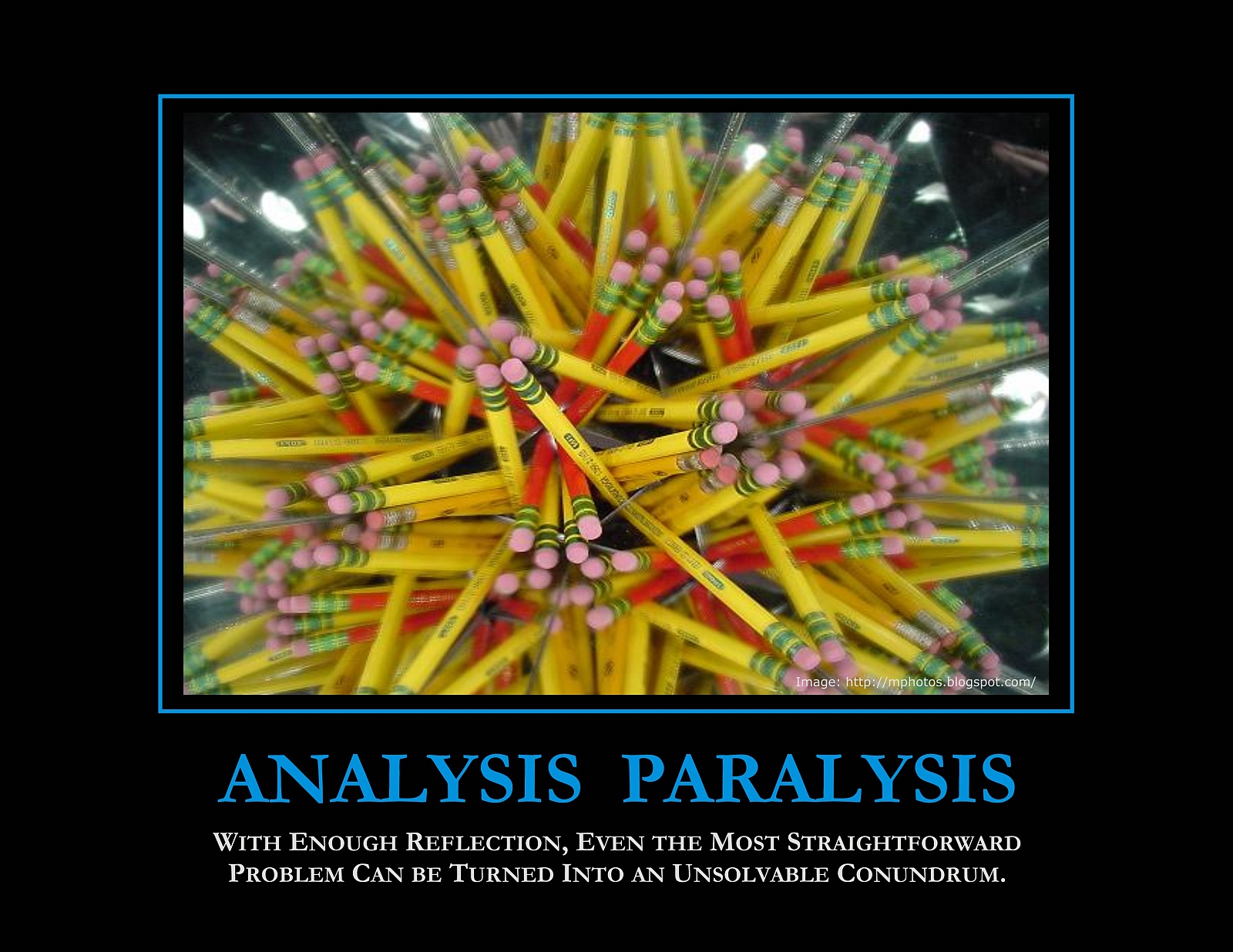
The example above illustrates how ridiculous it is to expect people to make 'rational,' calculated decisions every time they're faced with a choice. Can you imagine stopping to do a calculation like this every time you had to do something?! You'd never accomplish anything, because you'd suffer from "paralysis by analysis."

http://www.cogniview.com/blog/wp-content/uploads/2013/03/Analysis_Paralysis.jpg 

Thus, assuming that your goal is to be productive, it is therefore irrational to be rational!!!

To use the above example of waiting in a long line in order to save $0.10 per gallon on gas, you'd have to quantify everything: how much is your time worth? How much is your frustration worth? How much gas would your car would use at idle while you wait in line for a pump to open up? What is the 'opportunity cost' of  spending time waiting in line for a pump, waiting to pay at the counter, and trying to merge back onto the highway? Furthermore, as another commenter noted at the above article by I, Vigilante, what is the potential cost—in money, in time, and in trouble—of credit-card skimming, or the risk of total identity theft?

By the very nature of calculation, you need to fill in numbers here. But how can you quantify frustration in monetary terms? The very act of filling in this kind of equation requires enough guesswork to make the entire procedure an exercise in futility!

That's a hidden fact about math: it requires certainty about each term in the equation. Once you introduce guesswork, the equation becomes meaningless. It will still give you an answer, but to quote a popular proverb on the subject: "Junk in, junk out."

Essentially, acting in an ecologically rational manner is to adapt your behavior to suit the situation. Since every situation has different characteristics, it is foolish to behave the same way in all situations!

There are times in which deliberation and care are necessary before embarking on a course of action; there are other times in which quick, decisive action is needed. It is therefore impossible, on a practical level, to know in advance which kind of approach is best for solving a particular problem. One must first identify the nature of the problem, and any important features that may make this particular problem unique/different from similar situations one has already faced.


Academics tend to dislike such arguments, since this renders it impossible for researchers to determine in advance what the "correct" answer should be. After all, a researcher needs to present his or her ideas to skeptical peers! So it is far more defensible to tell your peers: "The correct answer is X, because this equation, based on principles of formal logic, has determined that the correct answer is X."

After all, the above approach has the appearance of airtight inevitability! If you say, "This equation yields X, therefore, the correct answer is X," you're much less likely to spark a heated debate than if you introduce the obvious subjectivity of "Situation P requires this equation, whereas Situation Q requires that equation. Since here, we have Situation P, this equation is necessary, so the correct answer is X. But if we changed these features, we'd have Situation Q, and the correct answer would be Y." An audience member could easily challenge you by objecting that we don't really have Situation P—we actually have Situation Q, or maybe Situation R. This debate could derail your entire presentation and make you look silly in front of a room full of your peers at a conference!

But is the point of research to avoid disagreement, or to advance knowledge?...

My overarching point is this: when academic research demonstrates that most people arrive at the wrong answer to a question, the participants' errors may be an artifact of the research process, NOT something inherently wrong with the human mind!

Next time a researcher tries to tell you that you're irrational, you shouldn't necessarily believe it...

https://www.walldevil.com/wallpapers/w02/853524-comics-nerd-philosophy-question-everything-stick-figures-xkcd.jpg

Wednesday, August 9, 2017

Multiple Regression Explained


How to interpret multiple regression

Regression is useful for making a predictive model. Let's say there's a positive linear correlation between K and N, but you suspect that Factors L and M also contribute to Outcome N


Make up a storysay, that Factors K, L, and M represent intelligence, persistence, and amount of sleep per night and N refers to a course grade.

So, to test the relative impacts of Factors K, L, and M on Outcome N, you can feed each factor into a regression model, and test whether each factor increases the fit. That is, a correlation between Factor K and Outcome N yields a Pearson's r of .64 and R2 of .4096. 

But, when you run a regression testing the effect of Factors K and L on Outcome N, you find an R2 of .5625, with a significant change in the R2 value. That means that Factors K and L together do a better job of explaining the relationship than Factor K alone. 

Then, you run a regression with Factors K, L, and M together, and find an R2 of .5929, with no significant changethis means that Factor M does not help to explain the relationship. Outcome N is due mostly to Factors K and L; Factor M is an unimportant predictor of Outcome N.

Voilà! There's regression in a nutshell! 

And, if you're confused about the math...remember in middle school or high school math, when you learned about "rise over run" and learned the formula y = mx + b? Yeah, that's a simple linear regression. With multiple regression, you can add multiple terms, such that y = ax1 + bx2 + cx3...+ z. But it's still the same concept, just with more predictors than that lone "mx" term.

In case you missed it, there are some fantastic, easy-to-use, and FREE stats programs available now! I review them here.
For more help explaining statistical concepts and when to use them, 
please download my freely available PDF guide here!
https://drive.google.com/open?id=0B4ZtXTwxIPrjUzJ2a0FXbHVxaXc

Saturday, August 5, 2017

When to use a chi-square


When to use a chi-square

Not clear about when you should use a chi-square vs. when to use a t test? 

First, you should check out my free, downloadable PDF, A Practical Guide to Psych Stats.

Now that that's out of the wayif you're still not sure, how about a tasty example? 
Let's say that we want to know whether a bag of Original Skittles has a truly random distribution of colors. If so, we’d expect to find roughly equal numbers of red, green, purple, yellow, and orange Skittles, right? 

A chi-square goodness-of-fit test [that is, a one-variable chi-square] can help us evaluate this. If there are 18 red, 13 green, 18 purple, 19 yellow, and 17 orange, the chi-square goodness-of-fit test tells us whether this distribution is different enough from an even distribution of 17 apiece (85 Skittles / 5 colors) that we can reject the notion that the colors are evenly distributed. 

If you're really curious about my made-up numbers, by the way, here's a straightforward, easy-to-use online calculator to help you: http://www.socscistatistics.com/tests/goodnessoffit/Default2.aspx

***
Now, let's say we’re looking for differences in the proportion of red Skittles to the other colors in a bag of Original vs. a bag of Tropical Skittles. 


In this case, we have two categorical variables [Original vs. Tropical Skittles, and unequal distribution of colors], so we would need a chi-square test for independence. The additional category makes the calculation a little more complex (but not if you use statistical software to handle the dirty work! 😊), but ultimately, we're looking at the same thing as before: are there roughly equal numbers of each type Skittles in each bag?

In case you missed it, there are some fantastic, easy-to-use, and FREE stats programs available now! I review them here.
For more help explaining statistical concepts and when to use them, 
please download my freely available PDF guide here!
https://drive.google.com/open?id=0B4ZtXTwxIPrjUzJ2a0FXbHVxaXc

Wednesday, July 26, 2017

The AI Apocalypse?


The AI Apocalypse?

Is AIartificial intelligence—hype or substance? Can machines think? Can they ever 
achieve consciousness? Will the AI "Singularity" eventually destroy us all?
 

ResearcherID